The AI Reputation Reckoning: Why Health Care Communicators Can’t Afford to Look Away
December 12, 2025
Artificial intelligence (AI) generated content is rapidly reshaping health care reputations. With nearly 40% of consumers turning to search engines for medical information—and a growing reliance on unverified AI summaries—health care communicators must urgently manage their organization’s “AI reputation” or risk losing trust and control.
AI-generated content is changing how patients and consumers see health care organizations and products, including pharmaceuticals. Managing your reputation in this new large language model (LLM) landscape is now mission critical.
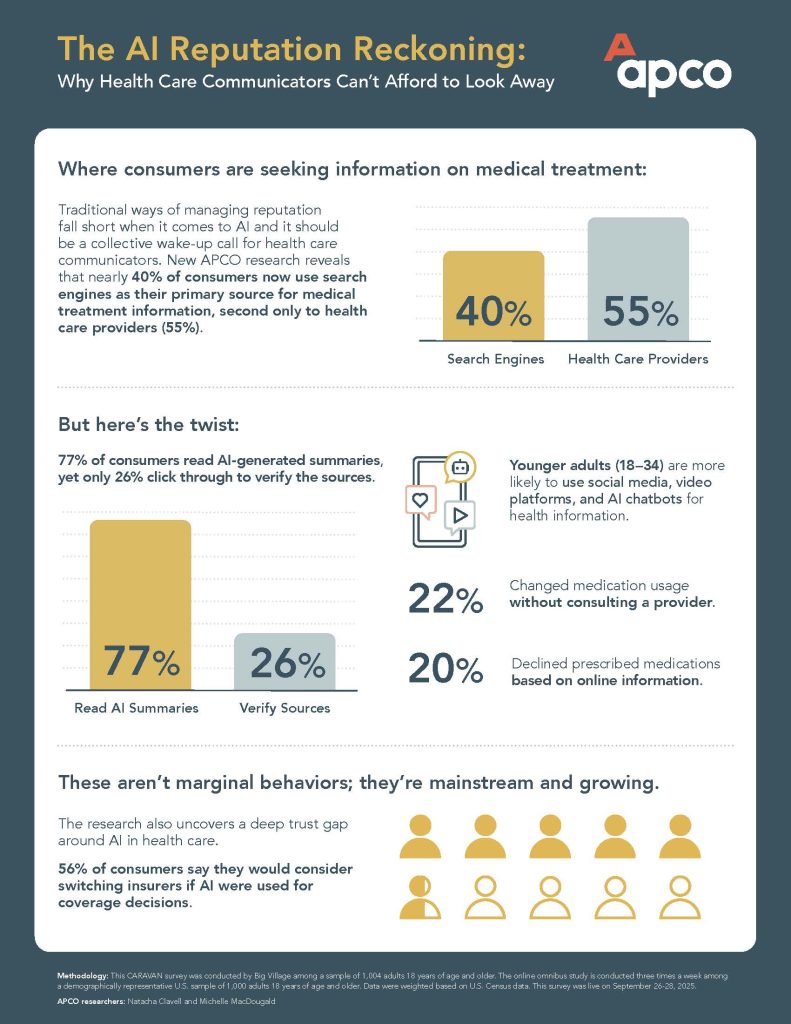
Traditional ways of managing reputation fall short when it comes to AI, and it should be a collective wake-up call for health care communicators. New APCO research reveals that nearly 40% of consumers now use search engines as their primary source for medical treatment information, second only to health care providers (55%).
But here’s the twist: 77% of consumers read AI-generated summaries, yet only 26% click through to verify the sources.
A growing number of medical decisions are being shaped by potentially unverified, AI-curated content. This trend is even more pronounced among younger adults (ages 18-34), who are more likely to use social media, video platforms and AI chatbots for health information. Alarmingly, the APCO research discovered that 22% of this group have changed their medication usage without consulting a provider, and 20% have declined prescribed medications, based on what they find online.
These aren’t marginal behaviors; they’re mainstream and growing.
The research also uncovers a deep trust gap around AI in health care. More than half (56%) of consumers say they would consider switching insurers if AI were used for coverage decisions.
The message is clear: If you’re not communicating in ways LLMs find your information, considering how AI weights content that highlights favorable, accurate information and if you’re not correcting misinformation, your brand equity will be in trouble. AI and LLMs need to be considered managed channels.
Passive crisis management—waiting until the damage is done—simply doesn’t cut it into an AI-driven world. AI platforms can generate and perpetuate false information about organizations, sometimes creating entirely fabricated claims that appear authoritative.
The stakes are too high for a “wait and see” approach. That’s why forward-thinking organizations are turning to proactive reputation intelligence. Solutions like APCO’s RepGenAI help organizations audit, monitor and influence how they’re represented in AI-generated content, transforming subjective concerns into actionable intelligence.
What must health care communicators do now? APCO’s RepGenAI provides the path.
First, recognize the AI reputation layer: Your organization’s “AI reputation” is now as important as your media coverage or website presence. Assume patients, payers and policymakers are encountering your brand through AI summaries first.
Second, audit your AI footprint: Don’t guess how you’re being represented. Find out. Tools like RepGenAI offer structured audits to reveal what AI platforms are saying about your organization, products and leadership. You must also understand the differences and preferences across all leading LLMs. One size will not fit all.
Third, prioritize proactive influence: Waiting for a crisis is not an option. RepGenAI doesn’t just report problems; it recommends how to influence AI models through targeted content, media partnerships and strategic publishing. AI platforms may weight academic journals or trade publications more heavily than mainstream media, requiring a shift in where you place thought leadership.
Fourth, close the communication gap: Make your use of AI clear, explain its benefits, and be transparent about decision-making processes. If a health insurer streamlines prior authorizations, for instance, tell patients how and why. Explain exactly what AI does and doesn’t do. Does AI only hasten approvals, but physicians still decide denials? If so, say so, using simple, direct language.
Fifth, treat AI risk like cyber risk: Just as organizations monitor for data breaches, you must monitor for “reputation breaches” in AI. This means continuous scanning, rapid response protocols and a culture of vigilance.
For health care communications professionals, the landscape has fundamentally changed. Patients, members and stakeholders are increasingly relying on AI-mediated information that operates outside traditional content controls. The organizations that will thrive are those that recognize this shift, invest in understanding their AI-driven reputation footprint and proactively shape how they’re represented in these new channels.